
Prologue
Fiscal year 2025 was a challenging yet highly successful year for ESWE Verkehr in many respects. Following several years of transformation and strategic realignment, we continued on our chosen path: focusing on our core business, strengthening operational stability, and setting a clear course for the future of public transportation in Wiesbaden.
Confidence in our services increased once again compared to the previous year. More than 60,000 subscriptions underscore this positive development. The Nerobergbahn achieved a new record, and our passenger survey also delivered improved results.
Our modernized operations control center became fully operational, and our bus depot was validated in accordance with the EMAS standard. With the introduction of our first fully electric articulated bus, we took the next step in the electrification of our fleet.
In 2025, we celebrated 150 years of Wiesbaden public transportation. At ESWE Verkehr, tradition and innovation go hand in hand. Looking ahead, 2026 will be dedicated to the intensive preparation of the network redesign, which is scheduled to be implemented in 2027.
None of these achievements would have been possible without the dedication of our employees across all areas of the company. We would also like to thank the representatives of Wiesbaden’s municipal government, the members of the Supervisory Board and Works Council, as well as our partners throughout the local community for their trust and support.
This annual report provides an overview of the key developments and results of fiscal year 2025. I hope you find it both informative and insightful.


Question 1
2025 was a special year for Wiesbaden’s public transportation system. What was the highlight of the past year at ESWE Verkehr for you?
In 2025, Wiesbaden celebrated 150 years of public transportation. Naturally, such an anniversary brings with it many memorable moments.
To mark the occasion, we transformed one of our buses into a small mobile museum: our Museum Bus. Throughout the anniversary year, it accompanied us to numerous events, bringing the history of public transportation in Wiesbaden to life for visitors.
One particular highlight was our large anniversary celebration at our depot, which attracted more than 3,000 visitors. Of course, a milestone year like this also includes the many festivals and community events held throughout the city and its surrounding districts, where our museum bus was proudly on display.
Question 2
Which achievement of ESWE Verkehr in the past year are you particularly proud of?
In 2025, we were able to deliver our full scheduled service program. Our shareholders provided the resources required to do so, and despite the many challenges facing the transportation sector, we not only remained within budget but also achieved an improved financial result. We are grateful for the trust and support of our shareholders.
Stability and reliability are essential to encouraging more people to choose public transportation. This was reflected in another increase in ridership during the year. The Nerobergbahn also achieved a new visitor record. Our extensive network of stops, frequent service intervals, and exceptionally low cancellation rate of just 0.4 percent contributed to higher levels of passenger satisfaction.
Last but certainly not least, we owe these achievements to the dedication and performance of ESWE Verkehr’s more than 1,100 employees. Every day, they work tirelessly to ensure that our buses operate safely and reliably throughout Wiesbaden, with 44 percent of the fleet already operating emission-free. A special thank-you goes to all our colleagues at ESWE Verkehr, who for the third consecutive year gave us even higher approval ratings as an employer in our annual employee survey.
Question 3
A modern organization is constantly evolving. What steps did ESWE Verkehr take in 2025 to strengthen its leadership team and further develop its corporate culture?
In 2025, ESWE Verkehr brought together managers from all departments and levels of the organization. Designed to take place outside the demands of daily operations, this format is intended to serve as a permanent platform for strengthening collaboration and fostering a shared understanding of leadership. After all, effective leadership is the foundation of a reliable, productive, and successful working environment.
The leadership conference laid the groundwork for new leadership guidelines across the company. Building on these efforts, we introduced a formal Leadership Charter that defines the standards by which we aspire to lead and against which we are prepared to be measured. This represents an important step forward for our organization, one that will continue to have a positive impact in the years ahead.
Question 4
In your view, which decision made in 2025 was the most significant for ESWE Verkehr?
One particularly positive development was the decision by the City Council in July 2025 to establish the foundation for the new Public Service Contract (PSC). In March 2026, the corresponding notice regarding the planned direct award was published, and in 2027 ESWE Verkehr is expected to be awarded the new PSC for a term of 15 years. This will provide the long-term planning certainty we need to successfully implement the major projects that lie ahead.
At the top of the list is the network redesign scheduled for 2027, which will provide Wiesbaden with a new, modern bus network that is even more closely aligned with the needs of passengers. In addition, we urgently require a second depot. Our current operating site simply no longer offers the capacity needed to support modern mobility services. The continued expansion of electric mobility requires additional charging infrastructure and, consequently, more space. New maintenance facilities are also urgently needed to meet today’s operational and servicing requirements.
Question 5
In 2025, your contract was extended early by another five years. Would you say this also reflects your own commitment to shaping the future of ESWE Verkehr?
Absolutely. I was very pleased by the confidence that the Supervisory Board expressed through this decision. I do not believe in doing things halfway, and despite the many challenges facing our industry, I look to the years ahead with great confidence, determination, and enthusiasm.
There is still much to accomplish, from the network redesign and the planning and construction of a second depot to the continued organizational development of our company. I am excited about the opportunities ahead and look forward to helping shape the next chapter of ESWE Verkehr’s success.

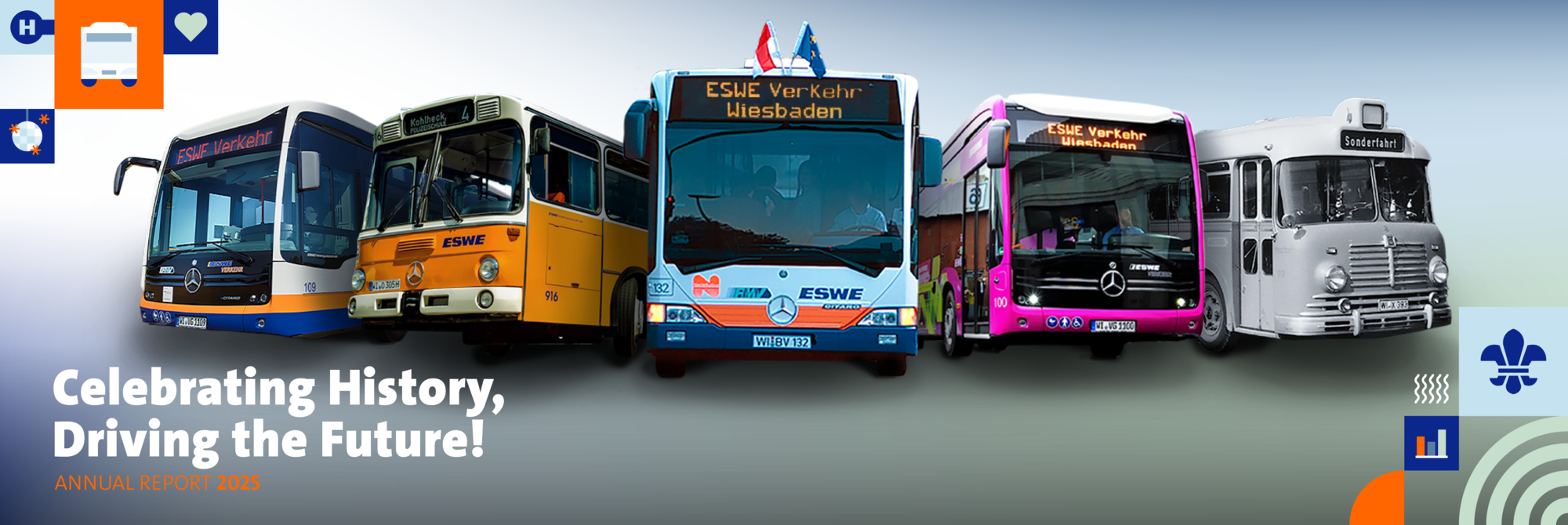
During the reporting year, ESWE Verkehr celebrated a special chapter in the city’s history: the 150th anniversary of Wiesbaden’s public transportation system. The anniversary provided an opportunity to honor the development of public transit in Wiesbaden and highlight the important role the company has played in ensuring mobility throughout the Hessian capital.
A new era of mobility began in Wiesbaden 150 years ago. On August 16, 1875, a horse-drawn tram carried passengers for the first time along a single-track route from Rheinstraße through the city center to the Nerotal valley. In 1888, the Nerobergbahn celebrated its inauguration and, to this day, continues to offer visitors a unique travel experience on Wiesbaden’s iconic hill.
From steam- and electric-powered streetcars to the bus services that have shaped urban mobility since the 1920s and continue to define the cityscape today, ESWE Verkehr looked back with pride on this long and distinguished history throughout 2025. The strong public response to the various anniversary activities underscored the close bond between the people of Wiesbaden and their public transportation provider.
Bringing History to Life
A key objective of the anniversary program was to make history tangible for residents across many parts of the city. To achieve this, a former transit bus was transformed into a Museum Bus featuring a mobile exhibition. The exhibition showcased artifacts and information spanning 150 years of public transportation history and also addressed the role of the transit operators during the Nazi era. The vehicle appeared at numerous events throughout the city, bringing local transportation history directly to the public. In addition, specially designed anniversary buses operating in regular service helped ensure high visibility for the anniversary year throughout the city.
The highlight of the anniversary year was the large celebration held at the company’s Gartenfeldstraße site in September 2025. More than 3,000 visitors took the opportunity to go behind the scenes of Wiesbaden’s mobility service provider. Vintage bus shuttle rides, tours of the company’s new operations control center, depot tours, and presentations on current projects and the future of public transportation attracted significant interest from guests.
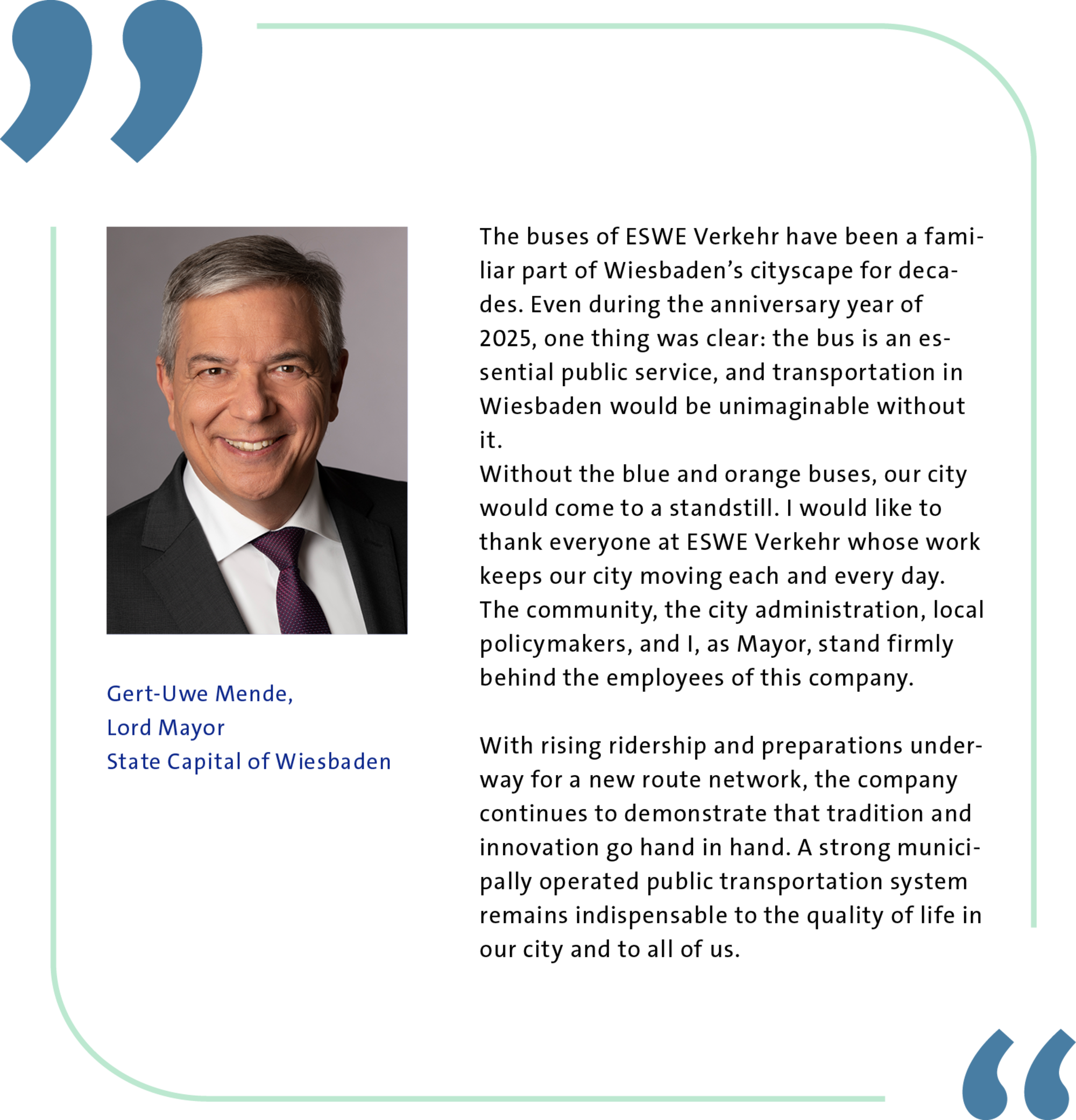
In special recognition of the occasion, Mayor Gert-Uwe Mende awarded ESWE Verkehr the City Plaque in Gold. Through this distinction, the City of Wiesbaden honored the 150-year history of its public transportation services and acknowledged the vital contribution ESWE Verkehr has made to mobility in the city.
Advancing Public Transportation for the Future
Managing Director Marion Hebding used the anniversary year not only to reflect on the past but also to look ahead. She emphasized the company's commitment to continuing to shape mobility in Wiesbaden for decades to come through the expansion of the electric bus fleet, the introduction of new service offerings, and the provision of high-quality, reliable public transportation.
With the launch of its comprehensively modernized operations control center in 2025, ESWE Verkehr laid the foundation for even more efficient and reliable service management. Following approximately ten months of construction, the new traffic control center entered full operational service in July 2025. It serves as the central command and monitoring hub for more than 40 bus routes across the Wiesbaden area and ensures the operational stability of scheduled service around the clock.
The operations control center plays a key role in ESWE Verkehr’s day-to-day activities. From this location, all scheduled services are coordinated, operational disruptions are managed, and communication with drivers is maintained through digital information and radio systems. Together with the field supervision and vehicle deployment teams, it forms the backbone of the company’s operational monitoring and control. A total of 32 employees work in rotating shifts 24 hours a day, 365 days a year, to ensure reliable public transportation throughout Wiesbaden.
Modernized Infrastructure and Workstations
The modernization was carried out while operations continued uninterrupted and included both a complete renovation of the facility and a significant technological upgrade. As part of the project, the network infrastructure was fully renewed, the workspace was expanded, and state-of-the-art information and communication technologies were integrated.
Key investments included a new multifunction video wall featuring eight 55-inch monitors with 4K resolution, as well as ergonomically designed workstations. Relocating the computer hardware also made it possible to create a significantly improved working environment. Total investment in the modernization amounted to approximately €600,000.
The new operations control center consolidates real-time data from across the entire transit network, including vehicle locations, scheduling and dispatch information, data from the electric bus fleet management system, and video and operational data from key traffic intersections. This enables faster decision-making and more efficient management of operational disruptions.
Building the Foundation for the Public Transportation of Tomorrow
With the successful modernization of its operations control center, ESWE Verkehr has strengthened the resilience and performance of its service management capabilities while creating the conditions for the continued digitalization of public transportation. The new facility therefore makes an important contribution to ensuring a reliable, customer-focused, and future-ready mobility offering for Wiesbaden.
With the launch of WiMobil, ESWE Verkehr took another step forward during the reporting year in the demand-driven and future-focused development of public transportation. Since December 2025, the new on-demand service has complemented the existing route network in the Wiesbaden-Biebrich district, providing flexible, demand-responsive connections between the town center, the residential area surrounding the cemetery, and Wiesbaden Ost station.
By introducing this new service, ESWE Verkehr is enhancing the attractiveness of public transportation, particularly in areas that have previously been served only to a limited extent by conventional bus services. At the same time, the project represents an important component of the planned development of Wiesbaden’s transportation network and provides valuable insights for the network redesign scheduled for implementation in 2027.
WiMobil is fully integrated into the regional transit network. Passengers holding a valid RMV ticket or Germany Ticket can use the service at no additional cost. The service operates with a fully accessible vehicle accommodating up to 16 passengers and offering ample space for strollers and mobility aids.
Flexible Mobility as a Strategic Building Block
The introduction of the on-demand service underscores ESWE Verkehr’s strategic commitment to integrating innovative mobility solutions with its existing scheduled transit network. The goal is to improve accessibility throughout the city, encourage greater use of public transportation, and contribute to a demand-driven and resource-efficient mobility system in Wiesbaden.
As a member of the Rhein-Main Transport Association (RMV), Wiesbaden became the eleventh RMV location to offer on-demand transit services with the launch of WiMobil. The positive experience gained from comparable services across the RMV network confirms the potential of flexible service models to close existing service gaps and align public transportation even more closely with passengers’ mobility needs.
In fiscal year 2025, ESWE Verkehr placed its first fully electric articulated bus into service. The new Mercedes-Benz eCitaro G entered operation on Wiesbaden’s route network and further expanded the company’s electric bus fleet.
The introduction of the electric articulated bus addresses the growing capacity requirements on heavily utilized routes. While articulated buses had previously been operated exclusively with conventional diesel propulsion, this new generation of vehicles now enables electrified operations on high-demand corridors as well.
The continued electrification of the fleet has already yielded significant progress. On school days, approximately 98 percent of all services are now operated using battery-electric standard buses. Overall, electric buses currently account for approximately 44 percent of total service output. By deploying its first electric articulated bus, ESWE Verkehr is consistently advancing this transformation while also gaining valuable insights to inform future vehicle procurement decisions.
High Capacity Through Modern Electric Mobility
Measuring approximately 18 meters in length, the eCitaro G can accommodate around 130 passengers and combines high passenger capacity with modern comfort and safety features. The vehicle is equipped with a battery capacity of 686 kWh, offers a range of more than 200 kilometers under real-world operating conditions, and features electric drive systems on two axles.
The bus operates with zero local emissions, thereby contributing to the reduction of CO₂ emissions, noise pollution, and air pollutants throughout the city. At the same time, operational experience gained in daily service provides an important foundation for the further development of the company’s fleet strategy.
It is also becoming increasingly clear that the continued expansion of the bus fleet, including the procurement of larger electric vehicles, is closely linked to the long-term development of operational infrastructure and the planning of a new depot.
The Next Step Toward Sustainable Mobility
Overall, the introduction of the first fully electric articulated bus underscores ESWE Verkehr’s commitment to actively advancing the transition toward sustainable mobility in Wiesbaden and establishing the foundation for a high-performing, future-ready public transportation system.
In 2025, ESWE Verkehr reached an important milestone in its environmental and climate management efforts: its bus depot was successfully validated under the European Eco-Management and Audit Scheme (EMAS). EMAS is one of the most demanding environmental management systems and imposes rigorous requirements regarding the continuous improvement of environmental performance, compliance with environmental regulations, and transparent reporting.
Systematic Environmental Management with Clear Objectives
The validation confirms that ESWE Verkehr has established a comprehensive environmental management system at its bus depot. As part of the EMAS framework, the company regularly identifies and evaluates its key environmental aspects and associated performance indicators. In addition, it defines specific environmental objectives and measures, reviews their effectiveness, and informs the public about its environmental performance through an environmental statement that is regularly updated and validated by an accredited environmental verifier.
As the central operating facility of Wiesbaden’s public transportation provider, the bus depot has a significant impact on the company’s environmental footprint, particularly with regard to energy and resource consumption, the energy sources used, emissions, waste generation, and water usage. EMAS validation provides a robust framework for systematically identifying opportunities for improvement, implementing targeted measures, and evaluating their effectiveness through transparent and measurable performance indicators.
At the same time, EMAS supports ESWE Verkehr’s strategic objective of advancing public transportation in a sustainable manner while continuously improving and reducing the environmental impacts associated with its operations. This approach extends beyond energy consumption alone. Additional direct and indirect environmental aspects are also systematically evaluated and incorporated into the ongoing development of the company’s environmental management system.
The successful validation is the result of the cross-functional collaboration of numerous employees and reflects a shared commitment to responsible and sustainable business practices. EMAS therefore represents an important building block in the continuous improvement of environmental performance at the bus depot and supports the achievement of ESWE Verkehr’s long-term energy, environmental, and climate protection goals.

59.6 million passengers
ESWE Verkehr recorded 59.6 million passenger journeys in 2025, an increase from 58.8 million in the previous year

66,424 Ticket Subscribers
Of ESWE Verkehr’s approximately 66,424 subscribers at the end of 2025, roughly 25,566 held a Germany Ticket, including customers using Hessenpass mobil, Job Ticket, and app-based ticketing options

12.8 million vehicle kilometers
ESWE Verkehr delivered more than 12.8 million vehicle kilometers in 2025, up from 12.5 million in the previous year

7,275 metric tons of CO₂ emissions avoided
Compared with conventional diesel buses, ESWE Verkehr avoided approximately 7,275 metric tons of CO₂ emissions in 2025, up from 6,922 metric tons in the previous year
315.285 passengers
The Nerobergbahn carried 315,285 passengers in 2025

119 electric buses
ESWE Verkehr operated 119 electric buses at the end of 2025

701 Kilometers of Route Network
ESWE Verkehr operated a route network spanning 701 kilometers in 2025

44 Bus Routes
ESWE Verkehr operated 44 bus routes in 2025
